Wednesday, April 09, 2008
Saturday, April 05, 2008
Recycled in Buenos Aires ...
The financial crisis in 2002 left a lot of Argentines out of work, but like every cloud it had a silver lining.
Or in this case, green.
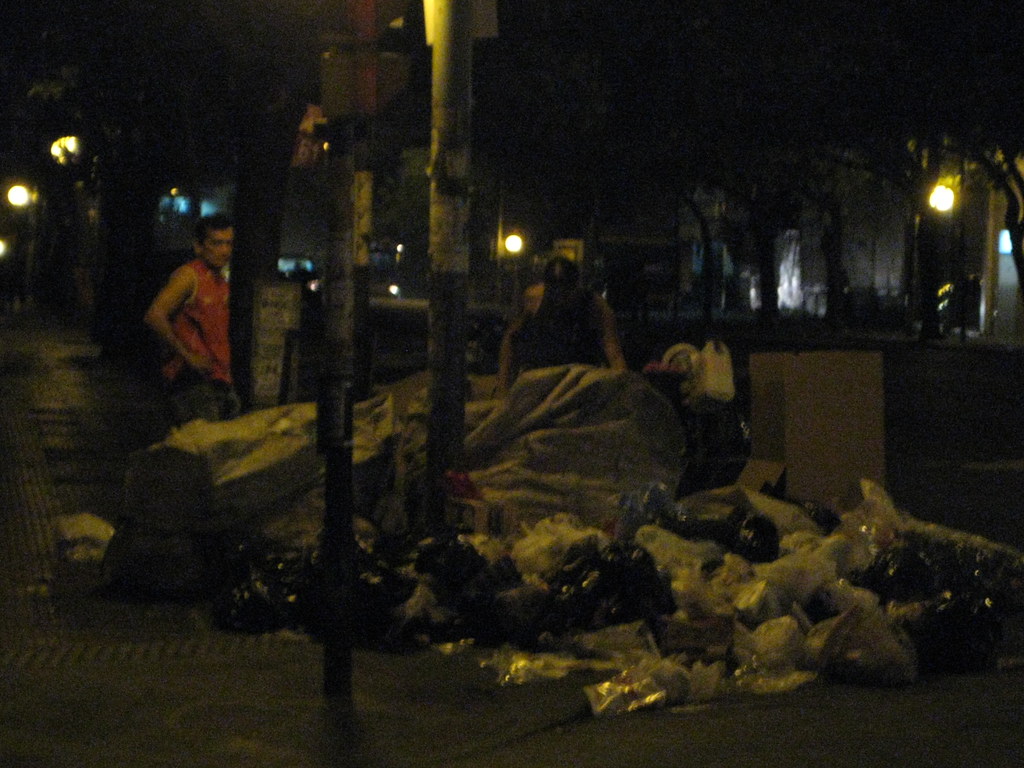
As businesses and housholds put their rubbish out every evening, thousands of unofficial recyclers descend on the city centre to sift through the days waste before the refuse collection lorries make their rounds. Cardboard seems to be the major prize on offer here - so much so that they even have a special name for the people that collect it.
Meet the Cartoneros.
Even in the so-called developed world it's fairly common to see the poor and homeless collecting aluminium cans for recycling (in Cambodia we even had kids following us, waiting to collect cans we were mid-way through drinking), but what really impresses here is the collective effort.
Households actually take the trouble to separate out the rubbish that has value (cans, carboard etc.) to make it easier for the recyclers to deal with. I'm not sure which is the biggest motivator, green tendencies, human empathy or just attempts to keep the street clean - either way the effect is great recycling.
The deposit of $1.50 (pesos) on a litre bottle is over half the cost of the actual beer ($2.70) - thus ensuring almost every bottle in the city gets returned to the brewery for refilling. Our local supermarket even reuses the plastic bag you bring the empties back with for the full ones.
I think the current bag has made about 25 trips now ...
My guide to using the Guia T has just been published over on Day 12, where my blog is also featured this month ...
Tuesday, April 01, 2008
getting stuffed on the empanada trail ...
We'll be leaving Argentina in a few days time, but I couldn't move on without giving a mention to the humble empanada.
A bit like an extra-tasty miniature cornish pasty, they are available with a wide variety of fillings and are sold absolutely everywhere, from bakeries to top-end restaurants as starters. To put it quite simply the Argentines are empanada crazy, and after several weeks here a little of the madness has rubbed off on us too.
So when our friend Sherri emailed from Melbourne with a link to this interesting article by Dan whose secret restaurant we visited the evening beforehand, we started to wonder, would be possible to visit each of the empanada vendors in a single day?
And what if you had to take public transport aided by a copy of the Guia T?
The gauntlet was laid down.
First came the planning. Aside from a couple of "hot spots" with outlets a few blocks apart the locations were spread throughout the city so it was important to try and minimise travel time and connections. I won't go into detail but let's just say it involved four hours, various improvised diagrams and quite a bit of swearing before I finally managed to map out a circuit in preparation for the following morning.
On the back of arriving home at 4am the previous evening, we didn't get started until 11.40am, and we set off for the 15 minute walk to the bakery of La Familia. Thankfully empanadas are great hangover food and served in Santiago de Estero style here they didn't dissapoint - still warm from the oven, the crisp light pastry was filled with a tasty mix of mince, onion and chopped egg. It was our first food of the day and we had to curb our natural instincts to order a second, remembering we had a further 9 stores to visit.
From here we jumped on the subway to the city centre and the small restaurant of Los Chilenos where we sat down and ordered a coffee and empanada apiece. Our waiter returned from the kitchen with devastating news. No empanadas due to lack of beef. It appears we are caught in the midst of a seige situation as farmers blockades attempt to starve the capital into submission. You can read more here.
We quickly moved on.
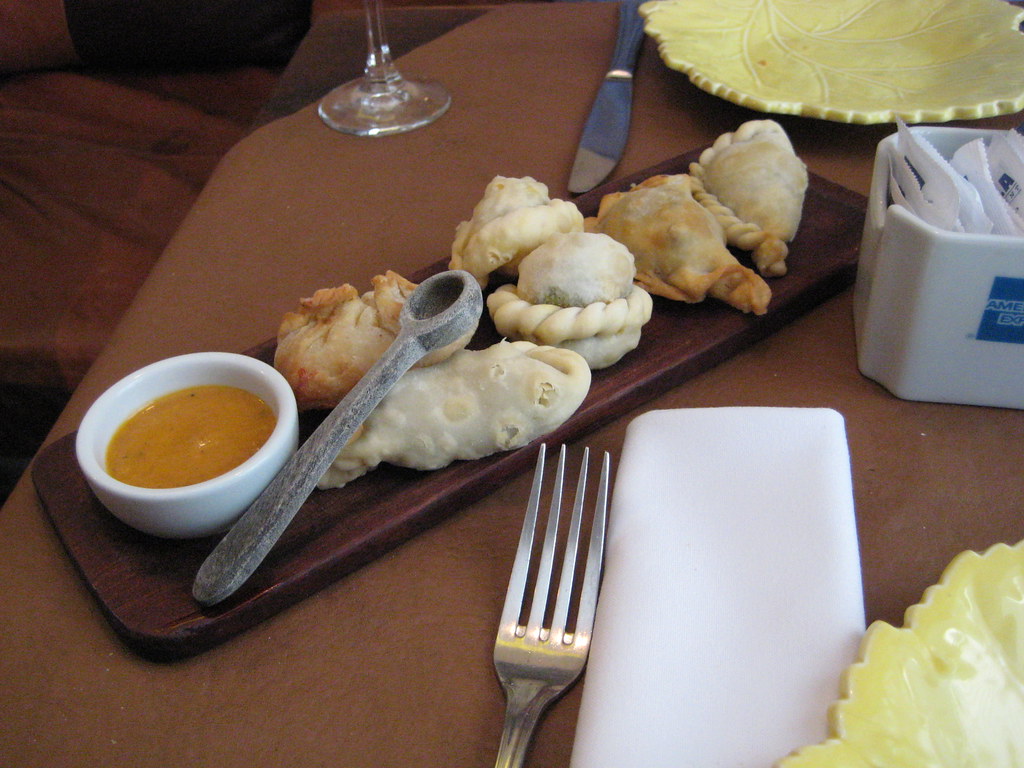
Just a few blocks away we found El Federal, specialising in Patagonian cuisine. Panic buying is a feature of all good sieges so here we decided to go for their tempting gustation platter (above) of 6 empanadas with beef, lamb, cheese and humita (sweetcorn & cheese) fillings. We found the pastry a touch greasy but the fillings were to die for, the best one being melt-in-the-mouth patagonian lamb.
Taking our first bus of the day to Barrio Norte we arrived at La Cocina - a cafeteria/takeway joint with walls covered in fading rock and reggae posters. We were back in pastry heaven with their Catamarca style empanadas, which we sampled in ricotta and ham, and chicken varieties. Even though we were beginning to feel a little bit sick we thought the fillings were pretty good too.
It was almost a relief when we found the nearby La Querencia closed as it gave us 30 minutes of digestion time while we took another bus out to the suburb of Palermo Viejo. Not only were both the restaurants here closed but Mel had started saying things like "I'm going to be sick" and "I'll get you back for this". It didn't bode well.
Other than a brief interlude where we unexpectedly found ourselves wandering through the middle of a film set as we walked through Palermo Viejo it had been a wasted journey. So when we arrived at our next destination in Belgrano to find it too was very much closed, it prompted Mel to unleash the threat of the ultimate weapon.
Handbag shopping.
We were on the next bus home.
Mel has an irrational fear of sweetcorn, an intolerance of peppers and quite frankly "wasn't in the mood" for the final one (not on Dan's list) I had with my coffee just before we caught the bus home, but here's how they stack up.
Marks for pastry and filling are out of 10, overall out of 20, averaged where applicable.
Pastry/Filling/Overall
La Familia
Carne 14
Mel 8/5
Mark 8/7
El Federal
Queso 10.5
Mel 5/6
Mark 5/5
Carne 12
Mark 5/7
Humita 11
Mark 5/6
Lamb 13
Mel 5/8
Mark 5/8
La Cocina
Ricotta/ham 14
Mel 7/7
Mark 7/7
Chicken 13.5
Mel 7/6
Mark 7/7
Pompeii
Rquefort 12
Mark 6/6
Moving on to stuffing of a different kind, I'm pleased to report that the eagle creek pack system is continuing to perform excellently. Although I didn't need to main bag for our recent trip to Uruguay I still used one of the cubes to good effect in my hand luggage.
If I'd started worrying that I was maybe taking things a bit too far by reducing my round-the-world luggage to a mere 12kg, then I needn't have. After checking out Crazy Eric's website I am reassured that I am a sane and well-adjusted individual. Just like he claims to be ...
Posted by
Mark
at
15:35
0
comments
Labels: buenos aires, el federal, empanada trail, get stuffed, la cocina, la famalia, los chilenos
Monday, March 24, 2008
back to winning ways ...
Boca dominated from the off, scoring twice in the first half (thankfully in the right net this time) and from there the victory never looked in doubt. Despite the consolation of grabbing a goal in the last minute of extra time Colon were, somewhat ironically, crap.
It just goes to show that perseverance pays off.
Seems that also goes for following the Leeds United results, also back to winning ways this weekend with a vital 2-0 win over Walsall. About time too. Perhaps my hopes of attending the play-off final in May aren't such a distant dream after all.
Those of you (or should I say both of you?) whose interest in difficult-to-use Argentinian publications has been ignited by my previous post on the Guia-T should head over to Mel's blog where the current subjects of discussion are Easter eggs and the local TV guide.
In other sporting news the holiday weekend closure of our gym has forced my new exercise regime outdoors for a run around the docklands of Puerto Madero (above).
Other than very sore legs I managed to acquire a spot of sunburn.
Which proves conclusively that I'm not yet running faster than the speed of light ...
Posted by
Mark
at
21:04
0
comments
Labels: argentina, boca juniors, bombonera, buenos aires, colon, puerto madero
Thursday, March 20, 2008
on the buses ...
It can be tricky to get a true sense of orientation in Buenos Aires.
The microcentre of chain stores with the docklands of Puerto Madero lying to the east is easy enough, but it's once you start moving outwards that the problems begin.
With a few notable exceptions, the cities architecture varies little as you move between different barrios (neighbourhoods) and distances can be substantial as you traverse the gigantic grid system that accomadates 13 million inhabitants.
Taxi's are pretty good value here and the fare may only have just reached the dizzying heights of a five pounds as you reach your destination, yet you suddenly realise that you've just spent yet another 40 minutes gazing out of the window as the cab twists and turns through the maze of one-way streets. It can be a pretty disorientating experience.
It was becoming clear that if we wanted to really get to know the city in our month here we would need to start working a bit harder. It was time to take to the buses, and so we went in search of information.
Enter the Guia T - the bible of bus travel in Buenos Aires.
Sitting down to study our new purchase I was still utterly confused after half an hour had passed. None of the 30+ street maps in the booklet had routes marked on them, and there were no timetables to be seen anywhere.
Sure enough, the directory of bus routes in the rear of guide would allow you to trace the route of any given bus from map to map, but this didn't seem much use without some way of knowing whether it's the correct bus to start with. With over 250 bus routes to plot it was going to take me a couple of days just to find the right bus. I was completely stuck.
In other latin american cities collectivo's are hail-and-ride minibuses that operate fixed routes and we'd used them on several ocassions previously. Armed with that piece of knowledge I had disregarded as irrelevant the grid of collectivo numbers on the left hand side of each map page.
As Mel cleverly pointed out, the missing piece of the puzzle is that buses are called collectivos here, and all of a sudden things started making sense.
Well almost.
It is still possibly the most confusing bus timetable on the planet.
Here's my easy-to-use, step-by-step guide to using the Guia T.
Step 1
Look up the street of your destination in the index (fig. 1) to find the map number and grid reference. This may span several maps.
Step 2
Find the correct cuadre (block) using the building number (e.g 360 Avendia Sante Fe).
The street number is marked periodically on the map pages (fig. 2), and most blocks cover exactly 100 (e.g. 500-600). You may have to track a long street over a number of pages to find the right block but you should easily locate your destination.
Step 3
Finding which bus routes pass nearby is now fairly straightforward. Your block will lie within a grid reference on the map (e.g. A3) and by looking at the corresponding grid on the left hand side of the map page (fig. 2) you can identify all the buses which pass through each gird reference.
Bear in mind that buses in adjacent grid references (which are several cuadres wide) may pass much closer to your actual destination, particularly if your destination is close to the perimeter.
Considering a 3-square block of 9 grid references is therefore good practice and should generate you a list of 10-50 potential buses serving your destination.
Step 4
Repeat steps 1-3 for your current location and compare results.
This should leave you with a short list of buses which travel from approximately your location, to your destination.
If there are no "matches" then you could consider changing buses.
A more effective strategy would be to catch a cab if you don't have time for the week of planning this would surely involve.
Step 5
In order to know where to get on and off the bus (essential information I feel) you now need to plot the route, using the street-by-street route in the bus index at the rear of the guide (fig. 3).
You don't need to do this in it's entirety, just for a few streets around your location and destination so you can (a) find the bus stop, and (b) have an idea of how you'll arrive at your desintation.
If you have more than one bus on your short list then repeat this exercise for each one - it could help avoid an unnecesary long walk at either end.
Beware the law of diminishing returns. Once you have located a bus within a short walk (say 5 cuadres) of either end you are unlikely to find a bus which saves more time than the effort required to locate it.
Advanced planners will select routes using major avenues as much faster routes for covering the same distance.
Step 6
Go catch your bus!
Walk to the street nearest your current location and walk along it in the direction of the bus route to find the bus stop with the corresponding number on it. The Guia T doesn't provide any times, but we've never had to wait for longer than 3-4 minutes for one to turn up.
You will need to tell your destination (using a cross street or a plaza) to the driver who will assign a price (usually 0.90 or 1.00 Peso) and you then drop coins of the same or higher value into the ticket machine behind him. Most will give change, but its important to know that you cannot travel without having coins.
Also most bus drivers seem to only speak and comprehend local slang and the Porteño pronunciations of Spanish, so take the Guia T and revert to pointing out your destination in the event your language skills fail you.
To alight just ring the bell a caudre or two before your intended intersection and you should end up somewhere close by.
And just for a moment I almost beleived it.
Posted by
Mark
at
15:48
0
comments
Labels: buenos aires, bus routes buenos aires, bus timetable buenos aires, catching buses, collectivo routes, collectivo timetable, guia t, travelling by bus in buenos aires
Monday, March 17, 2008
the draw specialist ...
Porteño's (as the locals are called) like their evenings late. Mostly people don't sit down to eat until 10 or 11pm, and the cities nightclubs don't even open until 2am - much less get busy.
How do they do it you might well ask? Well, we've been wondering too and after asking around the answer seems to lie in extended lunch breaks akin to the Spanish siesta and taking "disco naps" in between finishing work and heading out for the evening.
Accordingly our days here have taken on a similar pattern (or at least without the work) of late nights enjoying world class steaks and wines at seriously bargain prices, the occasional cultural activity in the afternoon, but generally focusing our attention on enjoying the excellent nearby cafes (above) and the relative novelty of domesticity.
Other than joining the local gym to help counteract the adverse effects of this lifestyle (most notably the rapid onset of Argie Belly) we seem to have fallen into a remarkably similar pattern to our first week here, with one exception.
This time the football season is in full swing.
First Sunday in town and I joined a football tour for the local derby match between Boca Juniors and Independiente at the legendary Bombonera Stadium (above), along with 65,000 passionate supporters who provided every bit as much entertainment as the on-pitch action.
It was my third game of the trip and after the games in Japan and Vietnam both ended in draws I might reasonably hoped for more of a result from this game. Despite Boca scoring twice without reply, the fact that first was in their own net after a failed clearance meant I had to settle for the usual result after what was otherwise a highly entertaining high tempo game.
With football tours costing 150-250 Pesos for a 20-30 Peso ticket with return transport, I was keen to try going to a game without all the tourist "packaging". The following Sunday, armed with nothing more than a copy of the local bus timetable, a smattering of basic spanish and a chap called Brian from Chicago I headed for yet another local derby, this time between River Plate and Racing.
With Brian and I both effectively falling into the category of "big lads" we were trying not to be too nervous about the fact that River is the current home of football hooliganism in Buenos Aires. Strength in numbers and all that.
It all started off fairly smoothly. Within minutes of stepping off the bus we managed to score some black market tickets for the populares (terraces) for a fraction of the cost of a tour and proceeded towards the stadium with the rest of the fans. It wasn't until then that I started spotting some notable differences to the Boca game.
Just getting into the ground we had to pass through four separate security check points, receiving a gentle pat down at each. Along the way we saw some of the locals being dragged off for rather more vigorous searches, some even being required to blow into a breathalyser to domonstrate their sobriety. Once inside the stadium and climbing the staircase to the upper stadium tier we found the concourse lined with about 200 police in full riot gear with shields.
We quickly found somewhere to sit, a nice shady spot right under the video screen behind the goal mouth with a great arial view of the pitch.
It wasn't until a couple of minutes before kick off as we stood wedged shoulder-to-shoulder with local supporters that the banners started unfurling and we realised we were right at the back of the "Borrachos" or translated to English "Drunkards" - River's ultra hardcore supporters.
It was a little like being in the front few rows of a rock concert, and almost immediately I started to regret my choice of footwear. Flip flops. With no easy way of getting to a calmer area we just did our best to join in as they sang an endless repetoire of songs about taking marjuana, cocaine and famous fights with the police and supporters of other clubs.
It was a pretty unique experience that you definitely don't get on a tour, but in all honesty it wasn't too easy to keep our attention on the game so at half time we moved to an area of equally passionate, but slightly less physical support to watch out the second half.
The final score?
A seemingly innevitable 0-0 draw.
Posted by
Mark
at
17:21
1 comments
Labels: black market, boca juniors, bombonera, buenos aires, buying tickets, disco nap, disco napping, football matches, football tours, independiente, racing, river plate, river plate stadium