Thursday, March 13, 2008

taking it all with a pinch of salt ...


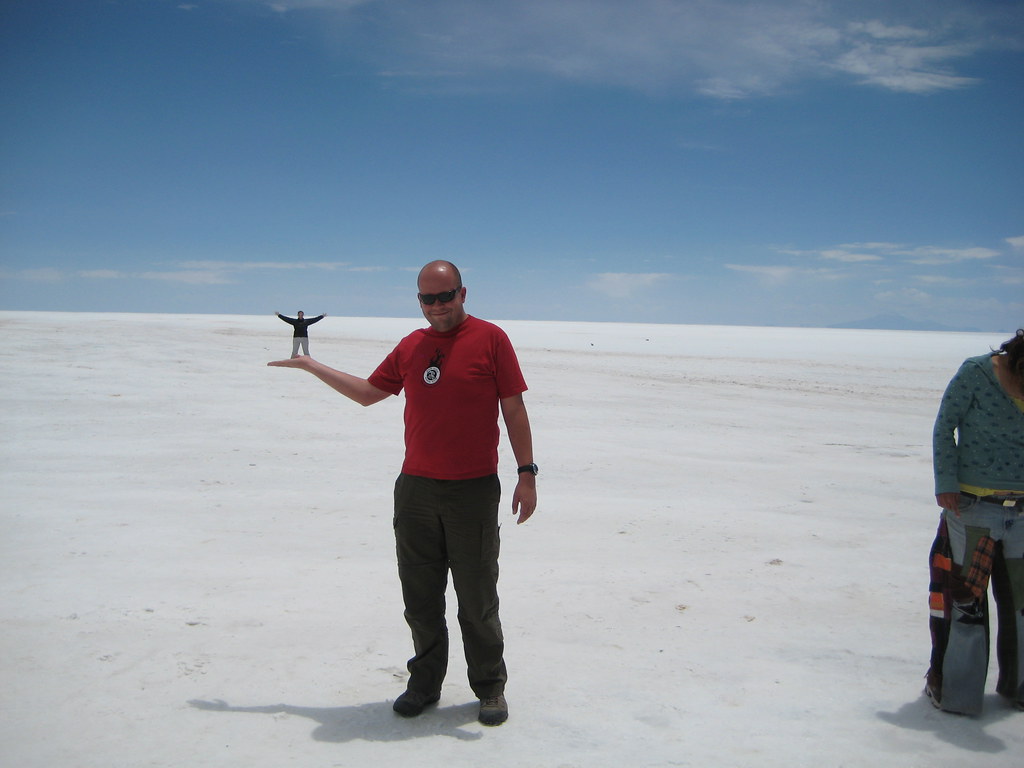
Is it just me, or does anyone else think Mel seems to have shrunk whilst we've been travelling?

Our final destination in Bolivia was the high altitude (3700m) "Salaar de Uyuni" salt flats, where we hooked up with our pal Kate and a few others for a 3 day trip.

The huge unspoilt scenery reminded a little of our trip around Mongolia, but with toilets. Over three days our trip took in everything from steaming fumeroles and geysers, to lakes packed with flamingoes, red lagoons, green lagoons and active volcanoes.

The best day by far though was the first as we headed out onto the salt flat itself. All 1000 square km of it. Trying to take photos, the reflected light was so blinding you almost couldn't see the resulting image on the LCD screen of your digital camera, but it was worth the effort as the unique perspectives allowed for some interesting photographs (see above).

At this time of year the rains cause large areas of Salaar de Uyuni to flood. So I wasn't really expecting it when our driver drove straight our Land Cruiser straight into the foot-deep brine as we progressed to the central area of the flats.

Not that I didn't think the vehicle could cope, just that with salt being a catalyst for rust it's hardly going to do much for the resale value of a piece of machinery that most likely costs more than the average house in Bolivia.


Our next stop was the incredibly unlikely sight of Incahausi Island. A huge rock formation jutting out of endless miles of salt and covered with giant cactus plants.
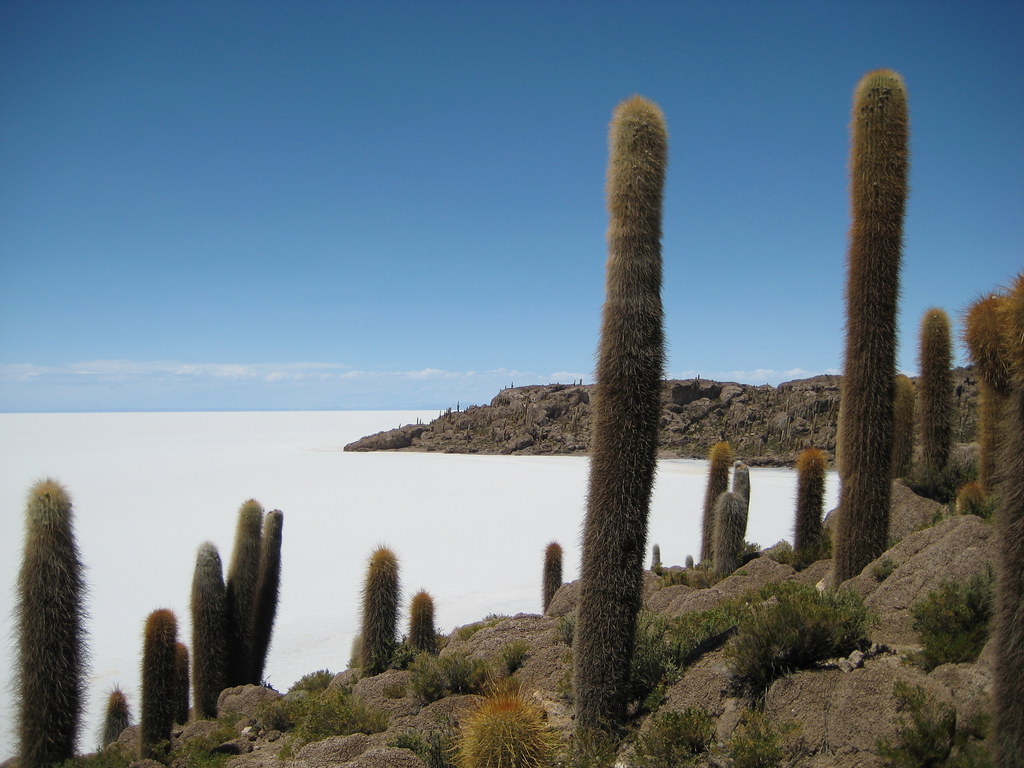
Despite being well aware of where I was, something about the endless white background was causing my brain to scream "an island of cacti..? in the snow..? you must be kidding!".

After climbing to the top the vistas became even more surreal as we enjoyed unninterupted 360 degree views for tens of kilometers to the mountains surrounding the flats, which, because of the intense light looked as though they were floating on mirages.

Returning to our vehicle we sat down to lunch at picnic benches and table crafted out of pure rock salt. It was all of about a minute into our meal before the obvious joke made it's first appearance of many - "has anyone seen the salt?" I enquired.

And who says my jokes are bad?

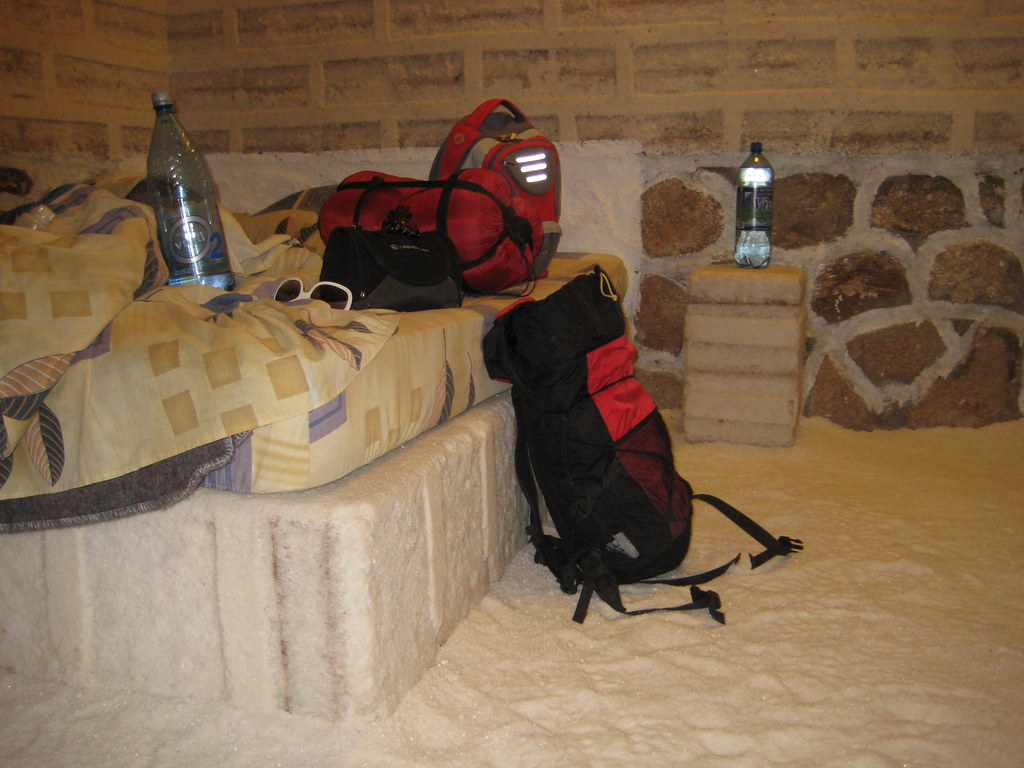
After leaving the salt flat we drove to a small village where we had the pleasure of staying in a small guesthouse constructed almost entirely of salt (we were noticing a theme developing). It was a real novelty staying here, but I don't really think it will catch on for comfort purposes.

Quite apart from anything else, I just can't imagine hoovering a floor like this.


You meet some real characters while travelling. Often eccentric and frequently seeking a little direction in life, but in our experience almost universally pleasant people to share a conversation and a beer with.

Not on this trip though.

We started to get the idea that one of our companions was a little odd over dinner that evening as he explained at length that since leaving the US military and spending the last four years travelling, he makes it a rule never to eat with tourists - preferring instead to eat in "places where no one else wants to". The undertone being that food poisoning is for wimps, not tough army guys like him.

Clearly we were not sufficiently impressed by this, so for his next trick he went fishing around in the communal soup pot for the chicken foot we had discovered a few minutes earlier (presumably added for flavouring) and started gnawing at it like a wild animal.

Here was a man who knows how to attract the ladies I thought - and in fact he did attract a few sideways glances from our Bolivian ladies doing the cooking for us.

I think most people would have given up at this point. Yet half an hour later when a selection of tea bags, mugs and a thermos of hot water arrived at our table he decided finish with one final act.

Taking one herbal and one ordinary tea bag he ripped them open and emptied the contents in his mug before adding hot water.

This did attract our attention.

He went on to explain that he had discovered he preferred it this way one time when he "got a bit too agressive" stirring his tea and the bag split, and he seemed utterly convinced that he was "getting more of the goodness this way".

There is a word for people like this, but it's not one I'll be using on my blog.

The following morning provided one of the high points of the trip. As we sat down to breakfast his girlfriend (who rather ironically is deaf) informed us he wouldn't be joining us, due to having spent most of the night making visits to the toilet.

We tried really hard not to laugh.

I'll let you decide how succesful we were.

Monday, March 10, 2008

world's most dangerous ...


With Mel over the border in Peru for a few days I decided to make my own little excursion into the rainforested lowlands of the Yungas region to see a very different side to Bolivia.

This was one trip where it would be every bit as much about the journey as the destination. My chosen mode of transport for the 64km to Coroico? By mountain bike down the worlds most dangerous road of course. You can read more about the terrifying Yungas road here.

After enjoying two rather sleepless nights in anticipation of the day I'd resorted to an extended session at the English Pub in La Paz on the pretense of "ensuring sleep". As a coping strategy it was rubbish.

I awoke at 4am in a cold sweat convinced of two things, firstly that adrenaline is a far more powerful drug than alcohol, and secondly that a high altitude hangover is terrible preparation for riding a bike within inches of the edge of 600m+ high cliffs.

We started by taking a minibus to the top of the snowy mountain pass high above La Paz at almost 5000m where we would start our ride, and spent the next half hour getting to know our bikes and kitting ourselves out with all weather gear.

Despite the fact that we were in Bolivia where people drive on the right hand side of the road, our safety briefing revealed a shocking piece of information. We would in fact be required to ride on the "scenic" left hand side of the road. Otherwise known as the side next to the huge drop.

It seems that where steep, unpaved, single track roads with precipitous drops are concerned the road rules are conveniently reversed. Logic being that left hand drive vehicles are safer driving close to the edge as the driver can look out the window to see how close his wheels are to the edge.

Whilst I couldn't dispute the logic, the fact that the road has consistently claimed 2-300 lives per annum didn't really fill me with confidence either. I could at least take a little comfort from the fact that I wasn't a bus, the mode of transport reputedly responsible for the majority of deaths.

In actual fact biking death road is quite a bit safer these days, since most of the traffic uses the quicker and considerably safer new road which opened in 2006 at a cost of $5m per km. That is unless it's blocked by landslides. Which being wet season it had been the previous day.

Today's outlook? Rain. A lot of rain.


In the end the torrential downpour that accompanied our descent turned out to be a blessing as far as my fear of heights was concerned. Not only did the cloud obscure the full extent of the exposure, but the new road remained open, leaving us to enjoy a very wet, but largely traffic free day as we hurtled down the 64km of downhill through landslides, waterfalls, streams and several hundred litres of mud, most of which seemed to have made it into my shoes by the time we reached the bottom.

Here's a short video one of us riding through a waterfall as we approach the most photogenic corner on the route. Just for the record I'm in 7th place, wearing a silver helmet - but as you'll see, it could be anyone.


Rather than return to La Paz with the group in the afternoon I'd arranged to stay in Coroico at the incredible La Senda Verde wildlife rescue centre. When the resident monkey population weren't unexpectedly jumping on my head from the treetops, they were engaged in a rather amusing running battle with the catering staff in their attempts to steal food.

The main protagonist always seemed to be Sambito the Spider Monkey (below) who had acquired an almost Che Guevara-like reputation around camp for his daring guerilla-style attacks on the kitchen.


Of course it wasn't just the staff who suffered at his hands.

On my first evening he jumped from behind onto my shoulder as I drank from a beer glass, with the inevitable consequence that I spilled the contents on the floor. He then proceeded to greedily lick up the evidence.

I'm convinced he planned it.

Then, as I sat waiting for my taxi to the bus station for the trip back to La Paz he struck again. As he jumped onto my lap I mistook his actions for genuine affection, that is until I felt the telltale warming sensation seeping through my jeans.

Through their barely stifled laughter the staff informed me he has a little difficulty controlling his emotions.

Lucky for him I have better control of mine ...

Friday, March 07, 2008

Homer erotic ...

I'm not awarding any prizes for most amusing use of Simpsons imagery on this trip.


But if I was, Belissimas "nightclub" in La Paz would have a strong claim on first place.


For the first time in what seems like weeks I've finally reached a decent internet connection (i.e. one which doesn't take an hour to load up 3 photo's), so next week I'll be able to bring you up to date on the rest of our exploits in Bolivia.

For now I've updated the beer league - best in Bolivia by a mile is Paceña's Pico de Oro, which translates to Little Piece of Gold - in a very respectable 13th place. It lives up to it's name in price as well as taste at 10 Bolivianos (or 65p) a 330ml bottle in the local bar - the same price as a pint of anything else here.

Sunday, March 02, 2008

seeing things in La Paz ...

After just an evening here in the world's highest capital city of La Paz, Mel has headed off to Peru for a few days.


I've decided to use the time to just hang out here for a few days while I plan my own little excursion to see a bit more of Bolivia. More on that later.


In between watching football and researching new beers in the bar, I've found some fairly unique sights in Laz Paz - from the slightly gruesome dried Llama Feoti (above) readily available from any number of stores to a surprising number of people urinating in the street in broad daylight.

Mostly they don't even bother finding a wall and just do it in the gutter facing the pedestrians walking along the street. Bolivia is a fairly poor country so I guess a significant number of people just can't justify spending the 50 centavos (3p) required to use a public loo. I can't really blame them, I just wish they were a little less open about it.

Perhaps one of the most memorable sights though are the two Zebra's (below) who can be seen directing traffic every afternoon at one of the city's busiest road junctions. Initially I presumed it was some form of advertising stunt, but there isn't a trace of branding to be seen.


I can only guess that someone at the council got the wrong end of the stick when they decided a Zebra Crossing was needed ...

Sunday, February 24, 2008

the two-and-a-half mile high club ...


It's been a while since the last update, so I'll let you know what we've been up to.

Our next stop was the worlds highest city of Potosi, a mere 4060m above sea level - the lack of oxygen had us gasping for breath just walking to the taxi rank at the bus station with our luggage.

In the days when much of South America belonged to Spain, Potosi's silver mine reputedly bankrolled their empire for almost two hundred years. Although much of the silver reserves are now exhausted the cities economy still thrives on mining, exploiting the areas rich mineral deposits.

Our main reason for coming here was to take a trip down a working mine. It promised medieval conditions - dust, intolerable heat, toxic gases, back breaking tunnels and climbing down crude stone shafts running with water in the pitch black. Not only that, but the opportunity to blow something up with dynamite sounded very cool indeed.

Talking over breakfast with some of the residents of our hostel about our intended trip we started hearing ominous phrases like "horrible", "couldn't breathe" and "glad to get out of there". It brought us swiftly to the conclusion that it probably wasn't going to a fun day out, so we decided to pass on it.

So, although Potosi is a pleasant enough city, we were left without much else to detain us so we decided to skip town a day earlier than planned to head for La Paz.

Our visit wasn't completely without reward though. Just before we left I noticed a surprising sight in the main plaza.


Looks like my old employer has started an exciting new venture in Bolivia ...